


Gastric Sleeve vs Gastric Bypass is a critical clinical comparison for individuals seeking a surgical solution to severe obesity. A Gastric Sleeve is a simpler, irreversible procedure that removes approximately 80% of the stomach to restrict food intake and reduce hunger hormones. In contrast, a Gastric Bypass involves both restricting the stomach size and rerouting the small intestine to limit calorie absorption, making it highly effective for severe type 2 diabetes and chronic acid reflux, though it carries a higher long-term risk of nutritional deficiencies.
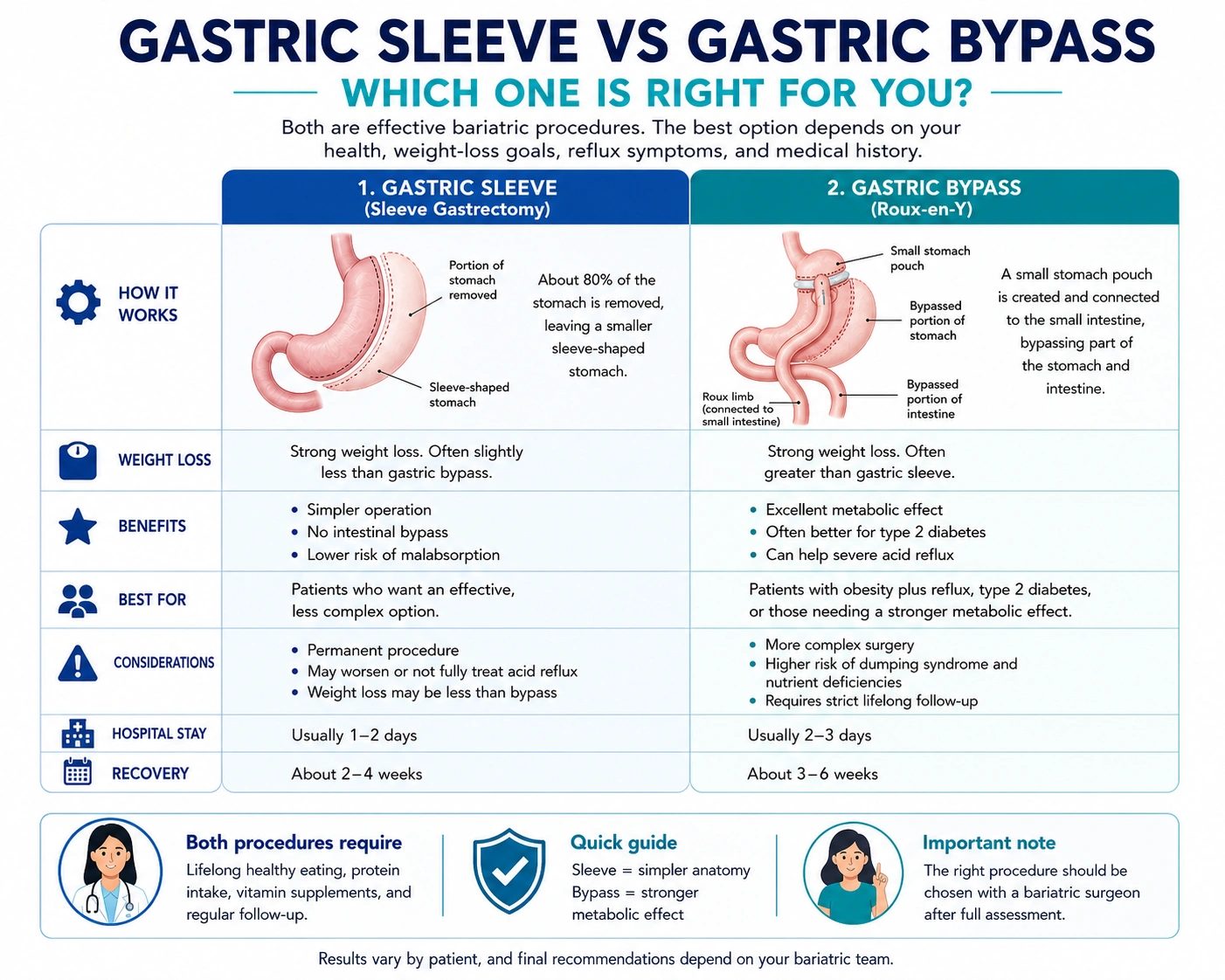
Choosing between the two most common types of metabolic and bariatric surgery can feel overwhelming. While both procedures achieve life-changing weight loss and metabolic improvement, they alter your anatomy differently.
Gastric Sleeve vs Gastric Bypass: How Each Surgery Works
Both surgeries are performed using minimally invasive laparoscopic (keyhole) techniques under general anesthesia, but their structural approaches to weight management diverge fundamentally.
Gastric Sleeve Surgery Procedure: What Happens Step by Step
Laparoscopic Sleeve Gastrectomy (LSG) focuses entirely on modifying the stomach structure without touching the intestines:
The surgeon inserts laparoscopic instruments through 4 to 5 small incisions in the abdominal wall.
The blood vessels supplying the outer curvature of the stomach are carefully separated.
Using a specialized surgical stapler, the surgeon cuts and permanently removes roughly 75% to 80% of the stomach.
The remaining stomach tissue is formed into a narrow, vertical tube or “sleeve” that holds about 100 to 150 ml of food. The excised portion of the stomach is removed from the abdomen.
Gastric Bypass Surgery Procedure: Roux-en-Y Method Explained
The Roux-en-Y Gastric Bypass (RYGB) is more complex, altering both the stomach volume and the digestive pathway:
The surgeon staples the top section of the stomach, separating it from the rest of the organ to create a small pouch that holds only about 30 ml of food.
The small intestine is divided into two sections. The lower part of the divided intestine (the Roux limb) is brought up and surgically attached directly to the new small stomach pouch.
The remaining, detached portion of the stomach and the upper small intestine are then reconnected further down the intestinal tract. This ensures that digestive juices can still mix with food to complete digestion.
Key Anatomical Differences: Restriction vs Malabsorption
Gastric Sleeve ➔ Pure Restriction (Smaller Pouch, Intestines Intact)
Gastric Bypass ➔ Restriction + Malabsorption (Tiny Pouch + Rerouted Intestines)
By leaving the intestinal tract untouched, a Gastric Sleeve relies purely on restricting the volume of food you can consume. A Gastric Bypass combines this restriction with malabsorption, intentionally limiting how many calories, fats, and nutrients your body can absorb from the food that passes through.
Gastric Sleeve vs Gastric Bypass: Results & Weight Loss Comparison
Average Weight Loss % at 1 Year and 5 Years
Both procedures deliver substantial weight reduction, but Gastric Bypass generally holds a slight edge in total weight lost and long-term maintenance.
| Metric | Laparoscopic Sleeve Gastrectomy (Sleeve) | Roux-en-Y Gastric Bypass (Bypass) |
| 1-Year Excess Weight Loss (% EWL) | 60% – 65% | 70% – 80% |
| 5-Year Weight Maintenance | Higher tendency for minor weight regain | More stable, long-term weight suppression |
Diabetes and Hypertension Resolution Rates Compared
Because Gastric Bypass alters intestinal hormones (incretins) immediately after surgery, it acts as a powerful metabolic intervention:
Type 2 Diabetes Remission: Gastric Bypass boasts a 75% to 85% clinical remission rate, often allowing patients to stop taking insulin or oral medications days after surgery. Gastric Sleeve has a respectable but lower remission rate of roughly 60% to 65%.
Hypertension (High Blood Pressure): Both procedures show comparable success, resolving or significantly improving high blood pressure in 60% to 70% of patients as systemic inflammation drops and body mass decreases.
Impact on GERD: Which Surgery Worsens or Improves Acid Reflux
This is a critical deciding factor for many patients.
Gastric Sleeve: Can cause or worsen Gastroesophageal Reflux Disease (GERD). Converting the stomach into a narrow high-pressure tube can force stomach acid upward into the esophagus.
Gastric Bypass: The standard clinical cure for severe acid reflux. Because the tiny stomach pouch produces very little acid and is completely disconnected from the lower digestive tract, acid reflux is almost instantly eliminated.
Gastric Sleeve vs Gastric Bypass: Risks & Complications
Short-Term Complication Rates: Leaks, Bleeding, Infection
Staple Line Leaks: A primary concern for both surgeries. A Gastric Sleeve features a long, continuous staple line, carrying a 1% to 2% risk of leaking fluid. A Gastric Bypass has shorter staple lines but multiple connection sites, carrying a similar 1.5% leak risk.
Acute Hazards: Bleeding along the surgical lines and internal blood clots (Deep Vein Thrombosis) occur at comparable rates (under 2%) across both options.
Long-Term Risks: Nutritional Deficiencies and Dumping Syndrome
Nutritional Deficiencies: Because a Gastric Bypass cuts out the primary absorption site for minerals, patients have a high risk of developing severe deficiencies in Iron, Vitamin B12, Calcium, and Vitamin D. Lifelong, high-dose bariatric supplementation is mandatory. A Gastric Sleeve carries a lower, more manageable risk of nutritional deficits.
Dumping Syndrome: Common in Gastric Bypass patients when sugar or simple carbohydrates pass too quickly into the small intestine, causing nausea, severe cramping, sweating, and rapid heart rate. This is rare in Gastric Sleeve patients because the natural stomach exit valve (pylorus) remains intact.
Revision Surgery Rates for Sleeve vs Bypass in Malaysia
Data from private and public hospitals in Malaysia indicate that the long-term revision rate is higher for the Gastric Sleeve. Approximately 10% to 15% of Gastric Sleeve patients eventually require a conversion to a Gastric Bypass later in life, primarily due to severe, unmanageable acid reflux or significant weight regain caused by the stretching of the sleeve pouch over time. Gastric Bypass revisions are rare and technically challenging.
Cost, Recovery & Choosing Between Sleeve and Bypass in Malaysia
Gastric Sleeve vs Gastric Bypass Cost at Private Hospitals
Bariatric packages vary across private medical centers in regions like the Klang Valley, Penang, and Johor:
Laparoscopic Sleeve Gastrectomy: Typically ranges from RM25,000 to RM35,000. The lower cost reflects shorter operating theater times and fewer surgical stapling cartridges.
Roux-en-Y Gastric Bypass: Ranges from RM32,000 to RM45,000. The higher price accounts for the complex dual-join technique, specialized surgical consumables, and prolonged anesthesia monitoring.
Hospital Stay and Recovery Timeline Comparison
Gastric Sleeve: Average hospital stay is 2 nights. Most patients return to light desk work within 7 to 10 days post-discharge.
Gastric Bypass: Average hospital stay stretches to 3 nights due to strict post-operative monitoring for early connection leaks. Returning to daily employment usually takes 14 to 21 days.
Both options follow an identical 6-week progressive post-op diet framework:
Clear Liquids (Weeks 1-2) ➔ Pureed Foods (Weeks 3-4) ➔ Soft Solids (Weeks 5-6) ➔ Normal Healthy Solids (Month 2+)
Who Should Choose Gastric Sleeve vs Gastric Bypass: BMI & Health Factors
Selecting the right procedure requires balancing your body metrics with your underlying health conditions:
Choose Gastric Sleeve if:
Your BMI is between 32.5 and 40 $\text{kg/m}^2$ without severe, long-standing Type 2 diabetes.
You have zero history of chronic acid reflux or GERD.
You take daily NSAID medications (like aspirin or ibuprofen) for arthritis, which are prohibited after a bypass due to ulcer risks.
You prefer a shorter operating time with lower chronic malabsorptive risks.
Choose Gastric Bypass if:
Your BMI is well over 45 $\text{kg/m}^2$ or you suffer from severe, insulin-dependent Type 2 diabetes.
You suffer from severe pre-existing acid reflux or a large hiatal hernia.
You are highly disciplined and willing to commit to taking comprehensive, multi-vitamin supplements every single day for the rest of your life.
Ultimately, your choice should be made in partnership with an experienced bariatric surgeon registered with the Malaysian Metabolic and Bariatric Surgery Society (MMBSS), ensuring your selected path aligns with your unique health profile.