
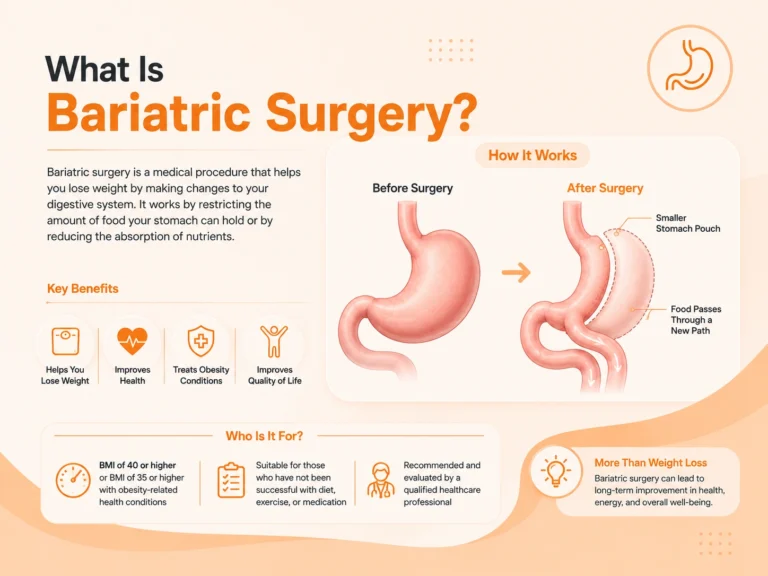
Bariatric surgery — also called weight loss surgery or metabolic and bariatric surgery (MBS) — is a group of procedures that help people with severe (class III) obesity lose weight by restricting how much food the stomach can hold, changing how the digestive system absorbs nutrients, or both. It’s generally an option once diet, exercise and medication haven’t produced lasting results, and most patients lose 50–70% of their excess weight within 1–2 years, often alongside remission of type 2 diabetes, high blood pressure and sleep apnea.
Bariatric surgery treats severe obesity by physically reducing stomach size, rerouting the digestive tract, or both. But it does more than limit food intake — these operations also change gut hormones that control hunger and blood sugar, which is why clinicians increasingly call the field metabolic and bariatric surgery rather than treating it as a purely restrictive or cosmetic procedure. According to the National Institute of Diabetes and Digestive and Kidney Diseases (NIDDK), weight-loss surgery is defined as “an operation that makes changes to your digestive system,” underscoring that its effects go well beyond appetite control.
It’s also not a first-line treatment. Surgical teams typically recommend it only after structured attempts at diet, exercise and — increasingly — anti-obesity medication haven’t produced enough sustained weight loss, or when obesity-related health problems make surgery the safer long-term option. Haven’t tried medically supervised alternatives yet? See our non-surgical weight management options.
Every bariatric procedure works through one or both of two mechanisms: restriction (physically shrinking the stomach so you feel full on less food) and malabsorption (rerouting the small intestine so fewer calories and nutrients are absorbed). A third, less obvious mechanism matters just as much — surgery lowers ghrelin (the “hunger hormone”) and boosts hormones like GLP-1 and PYY, which is why appetite and blood sugar control often improve within days, long before significant weight is lost. This hormonal shift is also why bariatric surgery is now studied as a metabolic treatment for type 2 diabetes and not just a weight-loss tool.
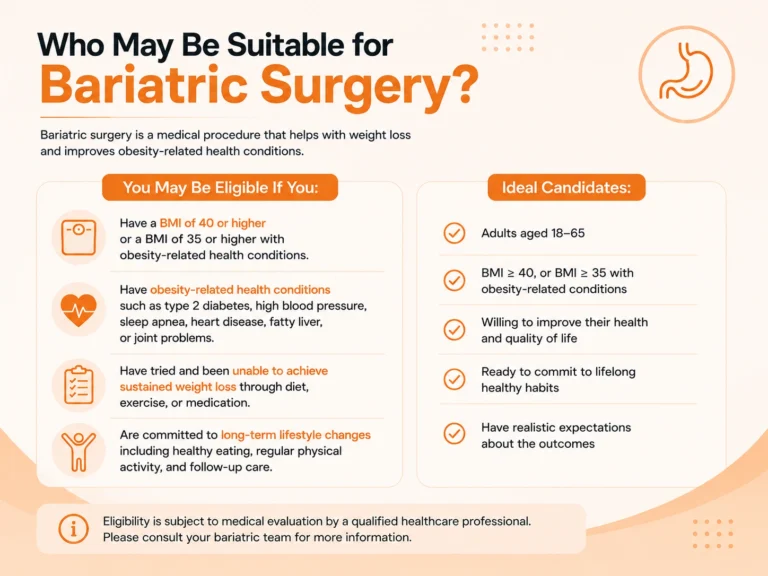
Eligibility is based on more than a single number on a scale — but Body Mass Index (BMI) is still the starting point most surgical teams use. If you don’t already know yours, our BMI calculator can give you a starting figure before your consultation.
| Criteria | BMI Threshold |
|---|---|
| Surgery generally recommended | BMI ≥ 40 (or ≥ 37.5 in some Asian-population guidelines) |
| Surgery considered with an obesity-related condition | BMI 35–39.9 with a comorbidity (type 2 diabetes, hypertension, obstructive sleep apnea, fatty liver disease, joint disease) |
| Metabolic surgery considered for uncontrolled diabetes | BMI 30–34.9 with difficult-to-control type 2 diabetes |
The 2022 joint indications statement from ASMBS and IFSO lowered the traditional BMI 35/40 thresholds and specifically recommends adjusting them downward for Asian populations, since obesity-related health risks tend to appear at a lower BMI in this group — directly relevant for patients in Malaysia and the wider Asia-Pacific region, and one reason “class III obesity” and “morbid obesity” thresholds are now applied more flexibly than a decade ago.
Beyond BMI, a full eligibility work-up also looks at:
The final call is made by a multidisciplinary team — surgeon, dietitian, and often a psychologist — not by BMI alone. Read more about how a pre-surgery assessment works before your first appointment.
Patients researching “bariatric surgery” often end up comparing it against less invasive options. Here’s the full landscape at a glance:
GLP-1 injections (semaglutide, liraglutide and similar drugs) have become a common first question patients ask before considering surgery. In general, GLP-1 medication produces more modest weight loss (typically 10–20% of body weight), requires ongoing weekly injections indefinitely to maintain results, and weight is often regained if the medication is stopped. Bariatric surgery produces greater and more durable weight loss (50–70% of excess weight), is a one-time procedure, and tends to produce stronger and faster diabetes remission — but carries surgical risk that medication doesn’t. The two aren’t always either/or: some patients use weight-loss injections before surgery to reduce operative risk, or after surgery to manage weight regain. Your surgical team can advise which sequencing, if any, makes sense for you.
Six main procedures are performed today, almost always using minimally invasive (laparoscopic or robotic) techniques.
| Procedure | How It Works | Avg. Excess Weight Loss | Reversible? | Typical Hospital Stay |
|---|---|---|---|---|
| Sleeve Gastrectomy | Removes ~75–80% of the stomach, leaving a narrow “sleeve” | 60–70% | No | 1–2 nights |
| Roux-en-Y Gastric Bypass | Creates a small stomach pouch connected directly to the small intestine, bypassing part of the digestive tract | 60–80% | Not typically | 1–3 nights |
| One-Anastomosis (Mini) Gastric Bypass | A simpler single-connection variant of gastric bypass; increasingly common in Asia and Europe | 65–75% | Not typically | 1–3 nights |
| Duodenal Switch (BPD/DS) | Combines a sleeve gastrectomy with a more extensive intestinal bypass; used for very high BMI patients | 70–80% | Not typically | 2–4 nights |
| SADI-S (Single-Anastomosis Duodeno-Ileal Bypass) | A simplified, single-connection variant of the duodenal switch; growing in popularity as a faster, lower-complexity alternative to BPD/DS | 70–80% | Not typically | 2–4 nights |
| Adjustable Gastric Banding | An inflatable band placed around the upper stomach to limit intake | 40–50% | Yes | Outpatient/1 night |
Two non-surgical alternatives come up often in patient consultations:
For every named procedure and how it works step by step, see the American Society for Metabolic and Bariatric Surgery’s procedure guide and Wikipedia’s overview of bariatric surgery. For our own detailed breakdowns, visit the gastric sleeve surgery, gastric bypass surgery, one-anastomosis gastric bypass (OAGB), and lap band surgery pages, or the full types of bariatric surgery overview.
Almost all bariatric procedures today are done using minimally invasive techniques rather than open surgery, through small incisions with a camera and long instruments (laparoscopic surgery), or increasingly with a surgeon-controlled robotic platform that offers finer instrument control and 3D visualisation (robotic bariatric surgery). Weight-loss outcomes between the two are broadly similar; the main practical differences are cost (robotic surgery typically costs more), operative time, and surgeon/hospital availability. Ask your surgical team which technique they use routinely and why — experience with a specific technique often matters more than the technique itself. Read more about laparoscopic surgery here.
This is the most common decision patients face. The two produce broadly similar long-term weight loss. Gastric bypass patients tend to lose somewhat more weight and see stronger diabetes remission. Sleeve gastrectomy generally carries a lower short-term complication rate, but a higher risk of acid reflux afterward. Your surgical team will weigh your BMI, diabetes status, reflux history, and personal preference before recommending one over the other. See our detailed sleeve vs. bypass comparison for a side-by-side breakdown.
As with any major surgery, bariatric procedures carry risk. Reported complication rates are generally 3–5%. For a full breakdown by procedure, see our risks and complications of bariatric surgery page, or the Cleveland Clinic’s bariatric surgery overview for how these are classified clinically.
Surgery changes the digestive system — but it doesn’t remove the need for lifestyle change. Long-term success still depends on the patient’s ability to sustain new eating habits, activity levels, and follow-up care. For a first-hand account of the pre-op risk conversation, the Mayo Clinic’s bariatric surgery guide is a useful independent reference to bring to your own consultation.
Most bariatric procedures take around 1–2 hours under general anesthesia and are performed laparoscopically or robotically through several small incisions — which is why recovery is faster than with older open-surgery techniques. You’ll typically be walked through the ward the same evening or the following morning to reduce the risk of blood clots, start on clear liquids, and have your pain managed with a combination of medications that minimise opioid use. Most patients stay in hospital for 1–3 nights depending on procedure type, as shown in the comparison table above.
| Stage | What to Expect |
|---|---|
| Day of surgery – Day 2 | Hospital stay, liquid diet begins |
| Week 1–2 | Return to light daily activity; pureed/soft food diet |
| Week 3–4 | Most patients return to non-strenuous work |
| Week 4–6 | Gradual reintroduction of solid food; light exercise resumes |
| Month 3–6 | Full recovery for most patients; rapid weight loss phase |
| Month 12–18 | Weight loss typically plateaus at its lowest point (“nadir weight”) |
See our post-surgery diet plan by week and exercise after bariatric surgery guides for what to do at each stage, and the NHS guide to weight loss surgery for an independent view of typical recovery milestones.
More than 90% of patients see meaningful, sustained improvement in weight and obesity-related health conditions after bariatric surgery. Results are usually measured in “excess weight loss” (the percentage of weight above your ideal body weight that you lose) rather than total body weight — most patients lose 50–70% of their excess weight, reaching their lowest (“nadir”) weight between 1 and 3 years after surgery. Results vary by procedure type, starting BMI, and how closely post-surgical diet and follow-up guidance is followed.
Cost varies widely by hospital, procedure type, and whether insurance or a government healthcare scheme covers part of the bill. What drives the price:
Pricing changes frequently and differs by clinic — always request an itemized quote directly from the hospital you’re considering, and confirm what is and isn’t included (follow-up visits, complications, supplements). See our full bariatric surgery cost breakdown, and if you’re a Malaysian EPF contributor, check your EPF withdrawal eligibility for bariatric surgery before booking. Also confirm with your provider on insurance coverage for bariatric surgery — coverage rules vary by policy and often require documented proof of prior weight-loss attempts.
Outcomes and complication rates depend heavily on surgical experience. Look for:
Our directory of accredited bariatric centres in Malaysia lists programmes by procedure type and location, and our guide to choosing a bariatric surgeon covers the questions worth asking at your first consultation. You can also read patient reviews of bariatric surgery with Dr. Navin Mann, whose practice was recognised at the GlobalHealth Asia-Pacific 2025 awards.
Bariatric surgery is the start of a lifelong process, not a one-time fix. Patients are typically expected to:
For the full day-to-day picture, see our life after bariatric surgery guide and long-term bariatric diet resource.
What BMI do you need for bariatric surgery?
Most guidelines recommend surgery for a BMI of 40 or higher, or 35–39.9 with an obesity-related condition such as diabetes or sleep apnea. Some patients with a BMI as low as 30–34.9 may qualify if they have hard-to-control type 2 diabetes.
What is the safest type of bariatric surgery?
Sleeve gastrectomy and gastric bypass are both considered safe when performed by experienced surgical teams, with overall complication rates around 3–5%. Sleeve gastrectomy generally has a slightly lower short-term complication rate; gastric bypass may offer stronger results for diabetes remission.
How much weight can you lose with bariatric surgery?
Most patients lose 50–70% of their excess body weight within the first 12–18 months after surgery. Results vary by procedure type and individual adherence to post-surgical guidelines.
Is bariatric surgery reversible?
Adjustable gastric banding and the gastric balloon can be reversed or removed. Sleeve gastrectomy, gastric bypass, duodenal switch, and SADI-S are generally considered permanent, though gastric bypass can sometimes be revised.
How long does recovery from bariatric surgery take?
Most patients stay in the hospital 1–3 nights, return to light activity within 1–2 weeks, and resume normal activities within 4–6 weeks. Full recovery and diet normalization is typically complete by 3–6 months.
Do you need to diet before bariatric surgery?
Many surgical programmes require a pre-operative diet (often low-calorie or liquid-based) for several weeks to reduce liver size and lower surgical risk. Your surgical team will confirm what’s required for your specific procedure.
Is bariatric surgery better than GLP-1 medication like Ozempic or Wegovy?
Neither is universally “better” — they suit different situations. Surgery produces greater, more durable weight loss from a single procedure; GLP-1 medication is non-surgical but requires ongoing injections and tends to produce more modest, less durable results if stopped. Some patients use both, in sequence, under medical supervision.
What happens if bariatric surgery doesn’t work or weight is regained?
Some patients need revision surgery — converting from one procedure to another, or tightening/adjusting the original one — if weight loss stalls, is regained, or complications develop. This is assessed case by case by the surgical team.
Does insurance cover bariatric surgery in Malaysia?
It depends on your specific insurance policy or employer health scheme. Many require documented evidence of a supervised weight-loss attempt and a qualifying BMI before approving the procedure. Confirm directly with your insurer and the hospital’s billing department.
If your BMI is 35 or higher — or 30 or higher with a condition like type 2 diabetes, hypertension, or sleep apnea — and diet, exercise and medication haven’t produced lasting results, it’s worth a consultation to review your options, even if you decide against surgery. Dr. Navin Mann, Consultant Bariatric, Metabolic & General Surgeon in Kuala Lumpur, offers a free initial consultation to assess your eligibility and walk through which procedure, if any, fits your health profile and goals — book your free consultation to get started.
Bariatric Surgery Malaysia Understanding Bariatric Surgery & Treatment Options
Bariatric Surgery Malaysia is an informational and patient coordination platform providing educational resources and non-clinical support for individuals seeking information about bariatric surgery. Where applicable, medical consultation, assessment and treatment are provided independently by Dr Navin Mann at licensed private healthcare facilities in Malaysia.
Bariatric surgery is a weight-loss procedure that alters the digestive system to help patients with severe obesity achieve significant, lasting weight loss. It works by restricting how much food the stomach can hold, reducing the body’s ability to absorb nutrients, or both, depending on the procedure. Common types include gastric bypass, sleeve gastrectomy, and gastric banding.
Bariatric surgery is typically recommended when diet and exercise alone haven’t produced lasting results and the patient’s weight is contributing to serious health risks.
EXCELLENT Based on 48 reviews
 Posted on Google
 Bard HishamHarap berbaloi untuk kesihatan yang akan datangPosted on Google
 Mumtaz BanuSaya adalah salah seorang patient yg buat bariatric dengan doc.Naveen. Operation saya pada 21/7/2025. Alhamdullilah setelah setahun saya buat review ini dengan jujur. Bariatric adalah operation yang paling disarankan untuk pesakit- pesakit mengalami masalah kesihatan. Saya mengalami sakit kencing manis yang tinggi dan Sleeping apnea . Setelah setahun alhamdullilah semuanya berubah menjadi elok dan sihat. Terima kasih kepada doc.Naveen dan staffnya. Saya share kan gambar sebelum dan selepas.Posted on Google
 Farah RaihanaThe price of the procedure at Dr Navin’s clinic are more affordable than most and good continuation of care before and after surgery 👍Posted on Google
 Nazifa Shazliservice paling bagus and rasa sangat puas hatiPosted on Google
 Chin GreysonWhat makes Dr Navin Mann different is that he combines surgical expertise with very modern and evidence-based approaches to bariatric care. He took time to explain newer techniques available and why certain methods may be more suitable depending on the patient’s condition. You can immediately tell that he is highly experienced and passionate about staying at the forefront of bariatric surgery. I felt very safe and confident under his care.Posted on Google
 Siti AminahSalam..saya adalah seorg pesakit yg telah menjalani pmbedahan bariatric di Damai Hospital Service.Sepnjg proses dr sebelum operation sehingga tamat sgt2 puas hati..semua staf sangat membantu..fasiliti hosp yg selesa..staf yg friendly..Dktr m'beri penerangan yg sgt jelas sblm dan slps operation..dietitian pula akan guide cara pemakanan dr sblm dan slps operation..alhamdulillah berat bdan sy turun hmpir 20kg dlm masa sebulan..byk prubahn dlm diri sy t'utama kesihatan smkin baik..Posted on Google
 Azijah JijahTuk buat bariatrik..jiwa kene yakin, & nekad semangat tuk lebih sihat kene ada..sakit pada awal ye..sihat tuk.selamaya..





Dr Navin Mann is a Consultant Bariatric, Metabolic & General Surgeon with expertise in minimally invasive (laparoscopic) surgical techniques.
His clinical focus includes:
Dr Navin Mann’s clinical practice includes the surgical management of obesity and metabolic conditions, as well as gastrointestinal, thyroid, breast and other general surgical conditions. Treatment options and suitability are determined following an individual clinical assessment, taking into account each patient’s healthcare needs.
Where surgery is indicated, procedures are performed at licensed private healthcare facilities in Malaysia where Dr Navin Mann is credentialed to practise.
Bariatric Surgery Malaysia provides educational information and patient coordination support. Medical consultation, assessment, treatment recommendations and surgical care are provided by the treating doctor and relevant licensed healthcare facility.


Bariatric surgery refers to a group of procedures that modify the stomach and/or intestines to help patients with severe obesity lose weight, by limiting how much food can be eaten, how many calories are absorbed, or both.
The main options are sleeve gastrectomy, gastric bypass, gastric banding, and duodenal switch. Your surgeon will recommend the best fit based on your weight, health history, and goals.
Generally, candidates have a BMI of 37.5 or higher, or 32.5+ with a related condition such as diabetes or high blood pressure, and have not achieved lasting results through diet or exercise alone.
When performed by an experienced surgical team using modern techniques, bariatric surgery carries a low complication rate. A pre-surgery evaluation identifies and manages your individual risk factors.
Preparation typically includes a medical evaluation, nutritional counseling, psychological assessment, and pre-surgery diet changes to reduce liver size and lower surgical risk. Your care team will guide you through each step.
Most patients lose 50–70% of their excess weight within 12–18 months. The exact amount depends on the procedure chosen, starting weight, and how closely post-surgery guidelines are followed.
Gastric bypass and duodenal switch can technically be reversed, though this is uncommon. Sleeve gastrectomy is permanent, as a portion of the stomach is removed during the procedure.
A typical hospital stay is 1–3 days, with a return to normal activities in 2–4 weeks. Most patients reach full recovery and adjust to their new diet within 6–8 weeks.
Yes. Long-term success depends on smaller portions, prioritizing protein, and taking prescribed vitamin and mineral supplements to avoid nutritional deficiencies.
Many patients experience significant improvement or remission of type 2 diabetes, high blood pressure, and sleep apnea after surgery, though outcomes vary by individual and condition severity.