

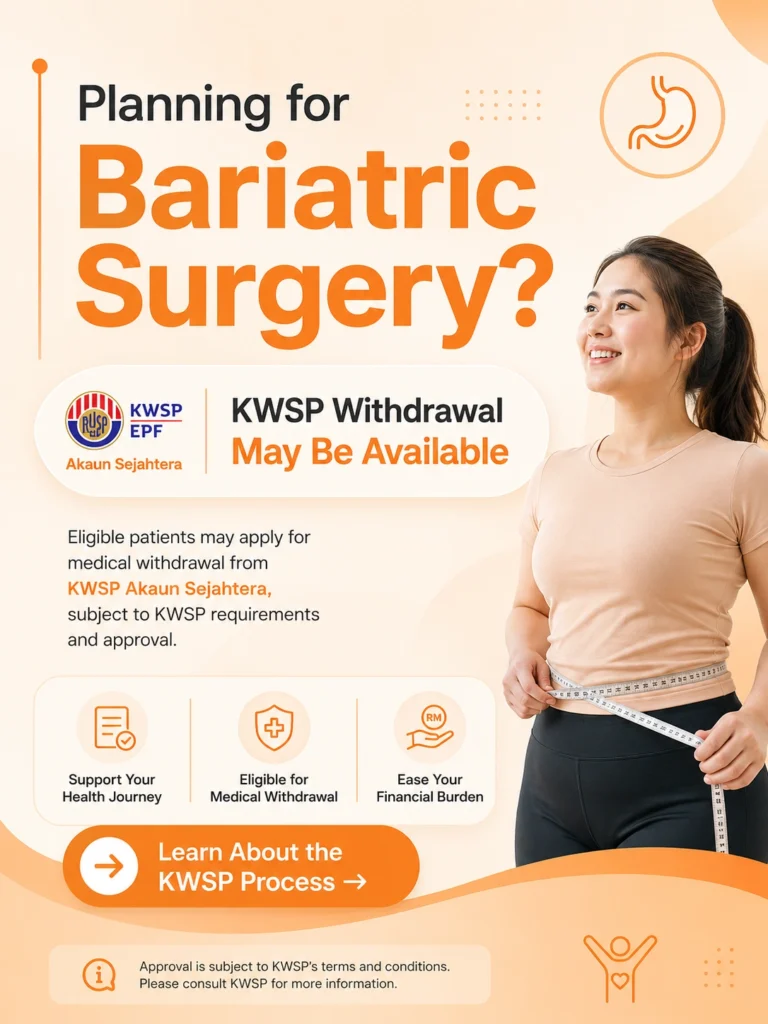
Yes — bariatric surgery is an approved condition under KWSP’s Health Withdrawal for Critical Illness, listed specifically as “Morbid Obesity or Obesity with Multiple Medical Complications and Life Threatening Requiring Bariatric Surgery.” This withdrawal is now drawn from Akaun Sejahtera (formerly known as Account 2). You can withdraw the lower of your actual medical cost or your full Akaun Sejahtera balance, subject to KWSP’s approval of your medical report and documents.
What Is “Account 2” Withdrawal Now Called?
KWSP restructured member accounts in 2024. What was previously called Account 2 is now split, and health-related withdrawals (including critical illness) are made from Akaun Sejahtera. If you see older articles referring to “Account 2 medical withdrawal,” this now refers to the same Akaun Sejahtera Health Withdrawal facility described on KWSP’s official page.
Who Can Apply
According to KWSP’s official eligibility criteria:
- Malaysians and non-Malaysians can apply
- Applicant must be below 55 years of age
- Applicant must have savings in Akaun Sejahtera
Additional requirements:
- Medical costs are not fully covered by an employer
- The illness or required medical aid/equipment is approved by EPF
- The patient is not receiving alternative treatments for the condition
Who the Withdrawal Can Cover
The withdrawal isn’t limited to the applicant. It can be used to fund treatment for:
- Yourself
- Your spouse
- Your children (biological, adopted, or step)
- Your parents (biological, adopted, step, or in-laws)
- Your siblings (biological)
Why Bariatric Surgery Qualifies
Bariatric surgery falls under the Endocrine/Medical category of KWSP’s approved critical illness list, specifically:
“Morbid Obesity or Obesity with Multiple Medical Complications and Life Threatening Requiring Bariatric Surgery”
This means a straightforward elective weight-loss request is unlikely to qualify on its own — the medical report needs to establish that the case involves morbid obesity with multiple medical complications, and that surgery is medically necessary rather than cosmetic.
How Much You Can Withdraw
Individual withdrawal: The lower of —
- Actual medical cost, or
- Entire savings in Akaun Sejahtera
Joint withdrawal (multiple family members contributing): The lower of —
- Applied amount, or
- Applicant’s entire Akaun Sejahtera savings, or
- Balance of treatment cost after deducting amounts already withdrawn by other applicants
If medical costs are partially covered by an employer, only the remaining uncovered balance can be withdrawn.
How Payment Is Made
- Payment to Member — if medical costs have already been paid (reimbursement)
- Payment to Local Medical Institution — if medical costs are still outstanding
For overseas treatment, payment is made via foreign demand draft (Brunei Dollar or Singapore Dollar) or foreign telegraphic transfer for other currencies.
Documents You’ll Need
Core documents:
- MyKad or original identification document
- Bank passbook/savings account statement or bank verification letter
- Form KWSP 3 (Pindaan) — required for mail submissions or if thumbprint verification fails
- Outpatient bill/final bill and original receipt from the medical institution (if already paid)
- Employer confirmation letter on medical cost coverage (if applicable)
- Medical Report – Critical Illness (LPP-1)
- Proof of relationship to the patient (if the applicant is not the patient)
Additional documents (local or overseas medical institutions):
- Proof of illness — original medical report (LPP-1), not older than one year from the withdrawal application date, complete with hospital stamp and attending doctor’s signature, stamp, designation, and discipline
- Proof of payment — actual medical bills and original receipts, not older than one year (an authorisation letter is needed if the receipt isn’t in the applicant’s name)
- Proof of identity — patient’s identification documents (if applicant ≠ patient)
- Employer’s letter of confirmation — required combination depends on who the patient is (member, spouse, child, parent, or sibling)
- Proof of relationship — marriage certificate, birth certificate, or adoption papers, if applicable
- Billing/invoice and payment receipt appendix (KWSP-prescribed format)
- Letter of payment confirmation and authorisation to apply for withdrawal
Form KWSP 9D (AHL) plus a copy of identification documents is required for submissions made by mail or through a representative.
How to Apply — Step by Step
- Get assessed by a doctor to confirm the case meets KWSP’s morbid obesity/bariatric surgery criteria.
- Obtain the official Medical Report (LPP-1) from the treating medical institution, completed and signed within the past year.
- Collect billing and payment documents — bills, receipts, and the KWSP billing appendix.
- Get an employer confirmation letter, if you or the relevant family member is employed.
- Certify all copies of your supporting documents through an authorised person (an EPF officer or another authorised certifier, per KWSP’s list).
- Submit your application — either online through KWSP i-Akaun, or in person/by mail using Form KWSP 9D (AHL) to your nearest EPF office or KWSP’s Kwasa Damansara office.
- Await processing — KWSP reviews the medical report and documents before approving the withdrawal amount and payment method.
Key Things to Check Before Applying
- Confirm your Akaun Sejahtera balance is sufficient to meaningfully cover treatment costs.
- Make sure your medical report explicitly documents the complications required under KWSP’s criteria — a general BMI reading alone is unlikely to be sufficient.
- If your employer covers part of the cost, you can only claim the uncovered balance.
- Documents (medical report, bills, receipts) must be dated within one year of your application.
- KWSP approval is not guaranteed — final eligibility is assessed case by case against EPF’s criteria.
Frequently Asked Questions
Can I withdraw KWSP Account 2 (Akaun Sejahtera) for bariatric surgery? Yes. Bariatric surgery is explicitly listed as an approved condition under KWSP’s Health Withdrawal for Critical Illness, provided your case involves morbid obesity with multiple medical complications and a medical report supporting the need for surgery.
Is “Account 2” still the correct term? Not exactly. Following KWSP’s account restructuring, health-related withdrawals are now made from Akaun Sejahtera, which replaced the relevant portion of the old Account 2 for this purpose.
How much can I withdraw for bariatric surgery? The lower of your actual medical cost or your full Akaun Sejahtera balance (for individual withdrawals), or a proportionate share if multiple family members are contributing under a joint withdrawal.
Does bariatric surgery need to be done in Malaysia to qualify? No. KWSP accepts claims for both local and overseas medical institutions, though the required supporting documents differ slightly between the two.
Will an elective weight-loss surgery automatically qualify? Not automatically. The listed condition specifically requires morbid obesity with multiple medical complications and life-threatening risk. A doctor’s medical report needs to establish this to meet KWSP’s approval criteria.
Where do I submit my KWSP withdrawal application? Applications can be submitted via KWSP i-Akaun online, at any EPF branch, or by mail to KWSP’s Jabatan Pengurusan Transaksi at Menara KWSP, Kwasa Damansara, Selangor.
Official Source
This article is based on information published by KWSP (Employees Provident Fund Malaysia) on the Health Withdrawal for Critical Illness page. Eligibility criteria, required documents, and processes can change — always verify current requirements directly on KWSP’s official website or with an EPF officer before applying.