

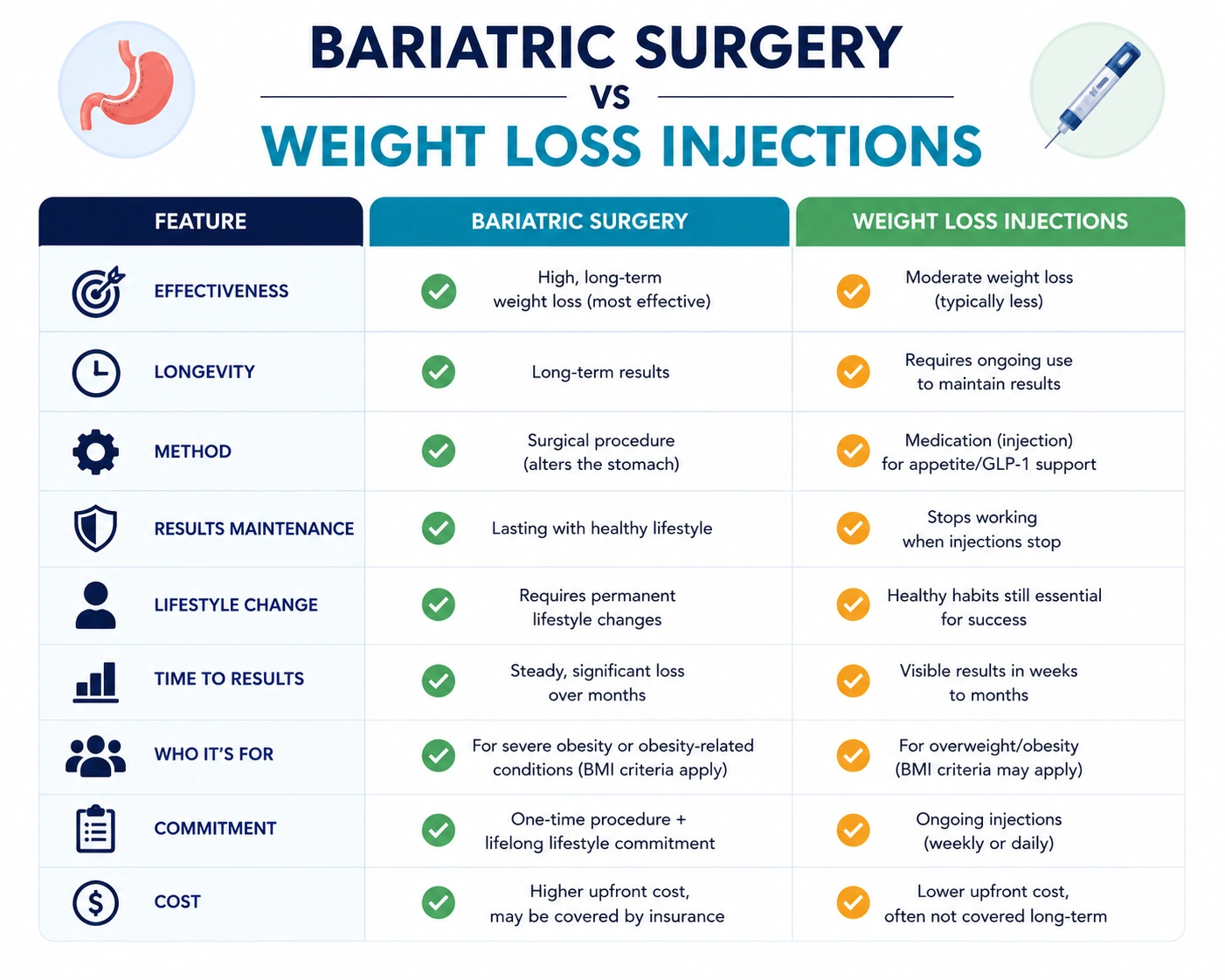
Bariatric Surgery vs Weight Loss Injections represent two distinct medical pathways for managing chronic obesity in Malaysia. Bariatric surgery is a one-time, permanent anatomical restructuring of the digestive system that offers substantial, long-term weight reduction (up to 30% to 40% total body weight loss) and puts metabolic comorbidities into deep remission. Conversely, weight loss injections—such as daily Saxenda or weekly Wegovy and Mounjaro—are non-invasive, ongoing hormonal therapies providing moderate weight reduction (15% to 20% total body weight loss) that typically requires continuous, indefinite use to prevent weight regain.
Bariatric Surgery vs Weight Loss Injections: Which Works Better in Malaysia?
The landscape of chronic weight management has shifted dramatically. Individuals with high Body Mass Index (BMI) levels are no longer limited to invasive operating tables; instead, they can consider highly advanced anti-obesity medications. However, choosing the most appropriate path requires comparing their physiological mechanisms, real-world success rates, long-term financial commitments, and risk profiles.
Bariatric Surgery vs Weight Loss Injections: How They Work
Both interventions modify your metabolic signaling pathways to curb appetite, but they achieve this through entirely different anatomical methods.
How Bariatric Surgery Causes Weight Loss: Restriction & Malabsorption
Bariatric surgery permanently alters your physical internal anatomy using minimally invasive keyhole procedures.
Restriction: Procedures like the Gastric Sleeve excise roughly 80% of the stomach, physically reducing its capacity to a narrow tube. This instantly limits the volume of food you can comfortably consume while eliminating the stomach tissue that secretes ghrelin (the hunger hormone).
Malabsorption: Procedures like the Roux-en-Y Gastric Bypass combine restriction with intestinal rerouting. By bypassing a major segment of the small intestine, your body physically cannot absorb all the calories, fats, and macronutrients from the food you digest.
How Weight Loss Injections Work: GLP-1 Drugs Like Saxenda & Wegovy
Weight loss injections do not touch your physical structures; instead, they function as chemical mimics of natural gut hormones. These medications belong to a class called GLP-1 receptor agonists (and GIP/GLP-1 dual agonists like Mounjaro):
Brain Signaling: The medication binds to receptors in the brain’s hypothalamus, turning off constant food cravings and significantly dampening your “food noise.”
Delayed Gastric Emptying: It drastically slows down the rate at which your stomach empties food into the small intestine. This keeping-food-longer effect translates directly into extended sensations of fullness after eating tiny portions.
Common Variants in Malaysia: Saxenda (liraglutide, injected daily), Wegovy / Ozempic (semaglutide, injected once weekly), and Mounjaro (tirzepatide, injected once weekly).
Key Difference: Permanent Surgery vs Ongoing Medication
Bariatric Surgery ➔ One-Time Anatomical Change ➔ High Permanent Lifestyle Adjustment
Weight Loss Injections ➔ Non-Invasive Chemical Therapy ➔ Requires Indefinite Treatment Continuity
The core difference centers on structural permanence versus chemical dependency. Surgery permanently reshapes your gut. Injections only manage the problem while the drug is in your bloodstream; if you stop taking the injections, your natural gut hormones reset to baseline, food noise returns, and weight regain typically occurs.
Results Comparison: Bariatric Surgery vs Weight Loss Injections
Average Total Weight Loss %: Surgery vs Injections at 1 Year
Clinical studies and local data from Malaysian metabolic clinics demonstrate a clear hierarchy in total body weight loss (TBW) potential over a 12-month timeline:
| Treatment Type | Specific Variant | Average Total Body Weight Loss (% TBW) |
| Bariatric Surgery | Gastric Bypass (Roux-en-Y) | 30% – 40% |
| Bariatric Surgery | Gastric Sleeve (LSG) | 25% – 30% |
| Weight Loss Injections | Mounjaro (Tirzepatide) | 15% – 20% |
| Weight Loss Injections | Wegovy (Semaglutide) | 12% – 15% |
| Weight Loss Injections | Saxenda (Liraglutide) | 8% – 10% |
Long-Term Weight Maintenance: 5-Year Data Compared
Bariatric Surgery: At the 5-year mark, surgery remains the most reliable method for maintaining significant weight reduction. While mild weight creep (around 5% to 10% from the lowest drop) can occur if poor habits return, the anatomical restriction continues working permanently.
Weight Loss Injections: 5-year data indicates that if a patient discontinues GLP-1 injections, they typically regain two-thirds of their lost weight within the first year alone. To sustain weight loss, injections must be used as a chronic, lifelong medical therapy, similar to taking blood pressure medication.
Impact on Diabetes, Hypertension, and Sleep Apnea
Type 2 Diabetes: Bariatric surgery (especially Gastric Bypass) provides an immediate metabolic reset, putting up to 80% of Type 2 diabetes cases into complete remission within days, often before significant weight loss even occurs. Injections offer excellent blood sugar control and high partial remission rates, but require active, continuous usage.
Hypertension & Sleep Apnea: Both options achieve significant improvements or resolution as body mass declines. However, surgery provides a faster, more complete cure for severe obstructive sleep apnea (OSA) due to the sheer velocity and volume of fat loss from the upper airways.
Cost, Risks & Side Effects in Malaysia
Bariatric Surgery Cost vs Weight Loss Injection Cost per Year
The financial commitment looks very different when comparing a one-time surgical cost against the compounding cost of ongoing monthly prescriptions.
Bariatric Surgery Cost: A one-time investment ranging from RM25,000 to RM45,000 in private Malaysian specialist hospitals. This all-inclusive fee covers the operation, ward stay, surgical consumables, and initial follow-ups.
Weight Loss Injection Cost: Prices scale based on your required maintenance dosage:
Wegovy/Ozempic: Ranges from RM890 to RM1,600+ per month (approx. RM10,000 to RM19,000+ annually).
Mounjaro: Ranges from RM1,400 to RM3,200 per month (approx. RM16,000 to RM38,000+ annually).
Financial Cross-Over: Within 1.5 to 3 years of continuous injection therapy, your cumulative out-of-pocket spending on medications will equal or exceed the total cost of a one-time bariatric surgery.
Surgical Risks vs Injection Side Effects: Nausea, Pancreatitis, Gallstones
Surgical Risks: While serious acute complications like staple-line leaks, internal bleeding, or deep vein thrombosis occur in fewer than 2% of cases, they can be life-threatening and may require emergency surgical revision. Long-term risks include chronic vitamin deficiencies and internal hernias.
Injection Side Effects: Injections avoid surgical complications but carry persistent gastrointestinal side effects. Over 40% of patients experience transient nausea, vomiting, acid reflux, and chronic constipation. Rare but serious risks include acute pancreatitis, gallbladder disease/gallstones due to quick fat drops, and a potential risk of medullary thyroid carcinoma.
Who Qualifies: BMI Requirements for Surgery vs Injections in Malaysia
Malaysian clinical guidelines enforce lower, more stringent criteria for surgery due to its invasive nature:
Injections Criteria: Open to adults with a BMI ≥ 30 kg/m², or BMI ≥ 27 kg/m²paired with at least one weight-related condition (e.g., high cholesterol or mild hypertension).
Surgery Criteria: Strictly reserved for individuals with a BMI ≥ 37.5 kg/m², or BMI ≥ 32.5 kg/m² alongside severe, life-threatening metabolic comorbidities like poorly controlled Type 2 diabetes or severe sleep apnea.
Choosing Between Bariatric Surgery and Weight Loss Injections
When Weight Loss Injections Are Not Enough: BMI Over 37.5
For individuals with Class III extreme obesity (BMI ≥ 37.5 kg/m² or ≥ 40 kg/m²), weight loss injections often act as a temporary measure rather than a complete long-term solution. When a patient needs to lose 50 kg to 100 kg to reach a safe weight range, the 15% average reduction provided by injections is rarely enough to resolve severe joint destruction, advanced fatty liver disease, or extreme cardiovascular stress.
When to Choose Surgery Over Injections for Long-Term Results
You should seriously consider bariatric surgery over medication if:
You have severe, long-standing Type 2 diabetes that is damaging your kidneys or vision, where instant surgical metabolic remission is critical.
You lack the long-term financial stability to spend RM12,000 to RM30,000 annually on lifetime out-of-pocket medication costs.
You cannot tolerate chronic GI side effects, or have a personal or family history of thyroid tumors or recurring pancreatitis.
Can You Switch from Weight Loss Injections to Bariatric Surgery?
Yes, this clinical pathway is becoming increasingly common in Malaysia. Many bariatric surgeons actively utilize GLP-1 weight loss injections as a pre-operative strategy.
For patients with extreme obesity, taking injections for 3 to 6 months before entering the operating theater shrinks an enlarged fatty liver and reduces visceral abdominal fat. This effectively lowers the technical difficulty of the operation, shortens anesthesia time, and significantly reduces immediate surgical risks and staple-line leak complications.